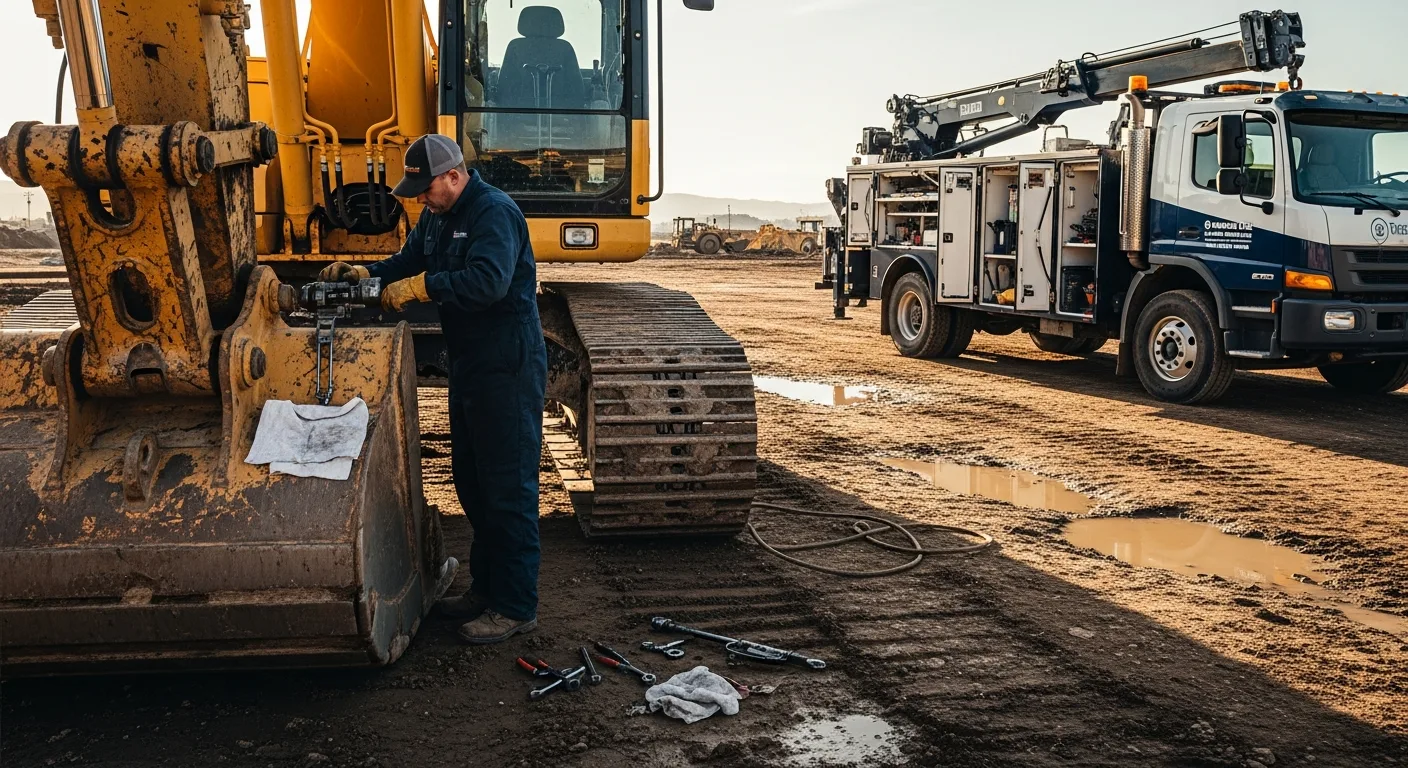
On-Site Heavy Equipment Diagnostics
30-day guarantee or 50 hours of run time

On-Site Heavy Equipment Diagnostics, $60 Flat

Diagnostics is the part of the job most shops skip. They read the code, point at the part the code mentions, and start swapping until the light goes away. That is how a $400 problem turns into a $4,000 invoice.

On-site diagnostics is the opposite approach. We plug into the OEM port, read live data while the machine works, and isolate the actual failure before any part comes out of the box.

What is included

Every job is scoped before any wrench turns. You see the diagnostic, you approve the work, then we move.

  • $60 flat-fee on-site diagnostic scan
  • Full OEM-level code read across engine, transmission, hydraulics, and aftertreatment
  • Live data review under load to confirm the failure
  • Hydraulic pressure testing where applicable
  • Electrical fault tracing with the OEM wiring diagram
  • Written diagnostic report with photos when useful
  • Clear repair quote with parts and labor broken out
  • Diagnostic fee applied to the repair if you authorize the work on the same visit

Who it is for

Owners who have already been to one shop, paid for a repair, and the same code came back. Operators who want a second opinion before authorizing a major job. Fleet managers who need a real diagnostic on paper before the next move.

What you get

A real answer in writing. The actual failed component identified, not the component the code happened to name. A repair quote you can compare apples to apples against any other shop.

Why T Baker Mobile

The truck is set up for diagnostics first. Late-model OEM software, the cables, the multimeters, the pressure gauges. Jacob has the field experience to tell the difference between a real failure and a sensor that lied.

How the job runs

No mystery. No drip-fed updates. Here is exactly what happens from the first call to the last bolt.

STEP 1

Schedule the visit

Tell us the machine and what it is doing. We book a window that fits both schedules.

STEP 2

Scan and verify

We connect to the OEM port, pull every code, and review live data with the machine under load.

STEP 3

Written report and quote

You get a clear summary of what failed, why, and what the fix costs in parts and labor. No pressure to authorize on the spot.

Why a code reader is not a diagnostic

A $100 code reader from the parts store gives you a fault number and a vague description. That is the start of the conversation, not the answer. Two machines with the same code can have completely different underlying failures. A P20EE NOx fault might be a bad DEF dosing valve, a clogged DPF, a wiring short, or a sensor that has drifted out of calibration.

Real diagnostics means looking at the actual sensor outputs, running active tests through the ECM, and confirming the failure before declaring it.

What live data tells us that codes do not

Codes are a snapshot. Live data is a movie. We can watch fuel rail pressure build under cranking, see if the boost is hitting target during a hard pull, or catch a hydraulic pump that goes soft at temperature. That is the level of detail that prevents a wrong-part purchase.

On hydraulic systems, live data plus a pressure gauge on the right test port will isolate a pump issue from a relief valve issue in about five minutes. Without that step, you are guessing.

The diagnostic report and what to do with it

Every $60 diagnostic comes with a written summary. You get the codes, the findings, the recommended repair, and a parts and labor breakdown. If you want us to do the work, great. If you want to take the report to your in-house mechanic or get a second quote, that is fine too.

The report is yours. The fee is for the diagnostic, not the right to use the information.

When a diagnostic saves real money

A common scenario: a track loader is in limp mode with a fuel rail pressure fault. The first shop quoted a new high-pressure pump at $3,200 plus labor. A diagnostic showed the rail pressure sensor was reading low while the actual rail pressure was on target. The fix was a $180 sensor and an hour of labor.

That is one example. It happens often enough that a $60 diagnostic is the cheapest insurance you can buy on a major repair.

Questions, answered straight

Is the $60 really flat?+

Yes. The $60 covers the truck roll, the OEM scan, live data review, and a written summary. If the location is well outside our normal service area, we will tell you up front before booking.

Does the $60 apply to the repair?+

Yes. If you authorize the repair on the same visit, the $60 is credited against the labor. If you take the report elsewhere, you pay the $60 and walk away with the diagnostic.

What brands can you diagnose?+

Most major heavy equipment brands. Bobcat, Caterpillar, John Deere, Kubota, Case, New Holland, Komatsu, Takeuchi. If your machine has an OEM diagnostic port, the laptop almost certainly speaks it.

Can you diagnose a machine that will not start?+

Yes. No-start diagnostics are one of the most common calls. We test the starting circuit, fuel system, and ECM communication on site.

How long does a diagnostic take?+

Most diagnostics take 60 to 90 minutes on site. Complex intermittent faults can take longer, and we will let you know if we hit one before the meter keeps running.

Will you give me a written report?+

Always. Every diagnostic comes with a written summary of the codes, the findings, and a recommended repair with parts and labor broken out.

Same-day response when the schedule allows

Get your machine back on the job

Skip the third voicemail to a shop that will not call back. Call Jacob direct and get a straight answer about your equipment.

Call 334-341-9277